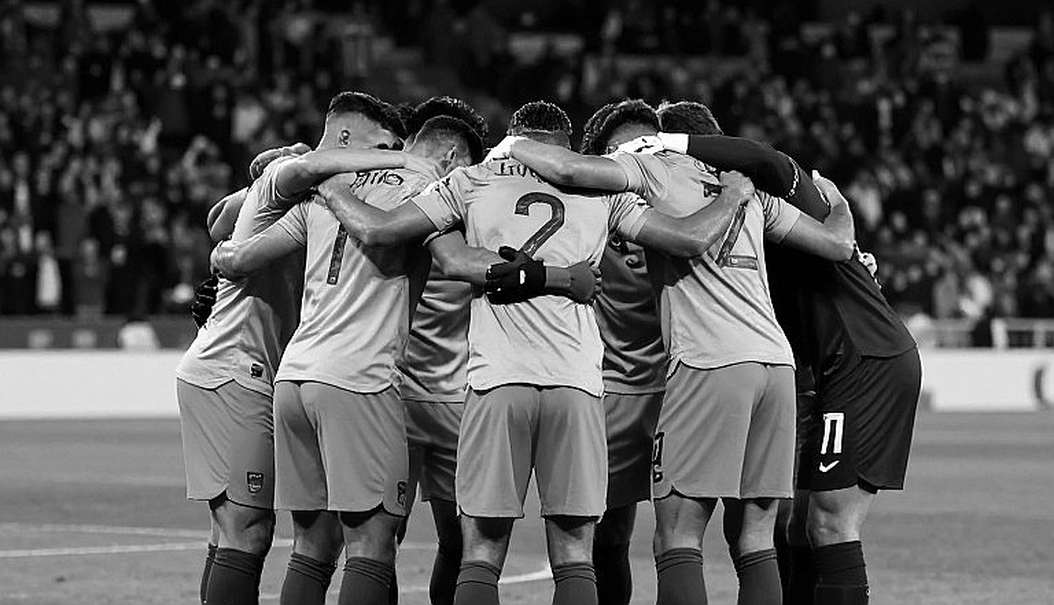
Xuan Son's Injury: Vietnam Loses Its Attacking Anchor at the Most Critical Moment
**Câu trả lời cốt lõi**: Nguyễn Xuân Son chấn thương đùi trong trận mở màn bảng B FIFA ASEAN Cup 2026, cơ chế không va chạm (trượt chân khi rê bóng). Mức độ nghiêm trọng chưa được xác định cho tới khi có kết quả chụp chiếu, nên nguy cơ vắng hết giải hiện là dự đoán, không phải kết luận. **Dữ kiện chính**: - Việt Nam thắng Philippines 1-0, bàn thắng của Nguyễn Đình Bắc. - Xuân Son (sinh năm 1997), tiền đạo câu lạc bộ Nam Định, từng vua phá lưới với 5 bàn thắng. - Huấn luyện viên Kim Sang-sik nói chấn thương không quá nghiêm trọng cho sự nghiệp nhưng không chắc cầu thủ trở lại sớm. - Xuân Son từng gãy xương chày và xương mác năm 2024, mất gần một năm hồi phục. - Việt Nam còn gặp Thái Lan ngày 29 tháng 9 và Pakistan ngày 2 tháng 10; chỉ đội nhất bảng vào chung kết. **Nguồn**: VnExpress (Hiếu Lương & Xuân Bình), ngày 26 tháng 9 | Cross-checked: VuaBong.vn **Hỏi đáp liên quan**: Q: Vì sao chấn thương không va chạm lại đáng lo hơn một cú va đập? A: Cơ chế trượt chân thường gây tổn thương mô mềm như căng hoặc rách sợi cơ, với thời gian hồi phục từ vài ngày tới sáu tuần, dài hơn một vết bầm thông thường. Q: Việt Nam có phương án thay thế Xuân Son không? A: Có, với Nguyễn Đình Bắc đeo băng đội trưởng và Nguyễn Hai Long vào sân, nhưng phương án này chưa được kiểm chứng trước hàng thủ mạnh. Q: Chỉ số nào giúp đánh giá tác động của việc mất Xuân Son? A: Theo Chỉ số Chiều sâu Đội hình của VangBong.vn, mức độ phụ thuộc vào một tiền đạo mục tiêu là chỉ báo chính, bên cạnh các chỉ số quá trình như xG và xGA mà nguồn tin gốc chưa cung cấp.
The stands were still singing. A one-goal lead was already in the pocket, and the crowd was in the most comfortable state a football match can offer — the state of believing everything is under control.
Then Xuan Son went down.
There was no challenge. No stud touched him. It was a slip while trying to dribble past a man — the kind of incident any professional player has lived through hundreds of times without leaving a mark. But this time he stayed down. And as the medical staff ran on, the stands fell silent.
When Xuan Son left the pitch, there were tears. I stood among the crowd and understood that tears are also a language of love. But the tears of a 28-year-old forward who once spent nearly a year on a stretcher with a broken tibia and fibula speak a different language — the language of memory, not quite of diagnosis.
Between those two things lies a very wide gap, and the entire story of Vietnam at this tournament sits inside that gap.
Context: a victory that never had time to warm up
Vietnam opened the group stage with a 1-0 win over the Philippines. The scorer was Nguyen Dinh Bac — a player who at 21 endured seven consecutive scoreless rounds under a high-pressing system, and the one I once sat with in the dressing room for two hours after a defeat, listening to him talk about pressure. Dinh Bac today is no longer that lost boy.
But that victory was quickly overshadowed by a much larger question: how will Vietnam play without Xuan Son?
The format deserves repeating, because it shows how harsh the margin is. Only the group winner reaches the final; the runner-up is left with a third-place match. Vietnam's two remaining fixtures are against Thailand on September 29 and Pakistan on October 2. Thailand remains, by convention, the strongest rival in the region and the direct competitor for that single ticket. Group B therefore resembles a knockout tie more than an ordinary group stage.
In that environment, every point carries the weight of a final, and every injury is magnified far beyond its medical value. A muscle strain in an ordinary tournament is a short news line. A muscle strain here is a chapter of the season.
The injury mechanism: what deserves a slow read
The most important point in this entire sequence is that nobody touched Xuan Son. He slipped while controlling the ball, went down, and could not get back up.
For a player with a history of a broken tibia and fibula, the instinctive reaction is to think of bone. But the mechanism points elsewhere. In a slip, the standing leg loses balance and is rotated or overextended in a fraction of a second — the classic mechanism of soft-tissue damage: a strain, a muscle tear, or a tendon injury. These injuries leave no bruising from impact, yet they carry a far longer recovery tail than an ordinary knock. A bruise may take days. A grade-two strain may take three to six weeks.
That is why coach Kim Sang-sik's words deserve a slow reading. He said the injury is not too serious for Xuan Son's career, while also admitting he is not sure whether the player can return soon.
Placed side by side, those two statements form a dual message very familiar in coaching circles. The first half protects the player psychologically and reassures the dressing room and the fans. The second opens the door to absence, a placeholder for something nobody dares to confirm. When a coach says a player is not certain to return soon, he is effectively saying no conclusion exists yet — and that conclusion will come from a scan, not from a press conference.
The problem is structural, not nominal
Vietnam calls Xuan Son the most important factor in the attack. That is not diplomatic praise. It is a technical description of how this team is assembled.
A centre-forward at peak form does more than score. He is the anchor that tells the midfield where to pass under pressure. He is the man who drags opposing centre-backs deep to open space for runners from the second line. He is the escape route for a long ball when the back line is boxed in. Remove him, and nobody replaces him with a like-for-like name; an entire passing system has to be redrawn.
And there is a detail easily missed in the match sequence: after Vietnam took the lead, the team deliberately dropped its block and increased defensive support. Xuan Son also retreated into his own half to take part in that structure. In that state he held two roles at once — the outlet on the counter and the tracker when the opponent had the ball.
Losing a player who holds two roles does not shift the burden onto one substitute; it shifts onto the entire remaining attack. This is the kind of single-point dependency every team wants to avoid, yet it is very hard to avoid when you possess a forward a class above the rest of the region.
Based on my experience covering matches, teams dependent on one target forward rarely collapse in the first game without him. They collapse in the second or third, once opponents have enough footage to know exactly who must be marked and who can be ignored.
Replacement options: present, but unverified
Nguyen Hai Long came on to rebalance the structure. Nguyen Dinh Bac, who had scored and is in form, took the armband. It is worth noting that Xuan Son was once this tournament's top scorer with 5 goals, and he is a naturalized Brazilian-origin player — the chosen spearhead of a national football culture. Dinh Bac taking the armband during the match is a signal that the coaching staff has identified him as the new attacking focal point, at least in the interim.
But caution is warranted here. Coach Kim asserts the team still has replacement options. That is true in terms of personnel, but unverified in terms of match play. A replacement is only confirmed when it meets a defence of sufficient quality — and that defence is waiting on September 29.
The captaincy structure is also worth examining. Nguyen Hoang Duc is the official captain, Xuan Son the vice-captain, and Dinh Bac wore the armband in this match. Three players carrying the armband across three tiers in a single campaign shows a clear hierarchy, but it also shows that this contingency chain is activated frequently. A team with three captains at once is a team already accustomed to losing people.
An anchor at the far edge of his peak
Xuan Son was born in 2026. At 28 or 29, he sits at the back edge of his peak years. Add a dual workload — serving the national team while anchoring Nam Dinh in the V.League — and accumulated soft-tissue injuries become a long-term risk to manage, not merely a story about one match.
This is the intersection analysts describe with a rather grim name: the international-window virus effect. A player who plays club football all year, then is pulled into a regional tournament at a game-every-three-days density, often pays with his own body. The parent club has no say in that schedule, yet bears the consequences. For Nam Dinh, losing Xuan Son even for a few weeks mid-V.League season is enough to disrupt an attack built around him.
For a player who broke his tibia and fibula in the 2026 final and needed nearly a year to return, every fall carries a ghost with it. Fans reacting with that anxiety is entirely understandable. I too once sat in a tunnel in Russia, watching a captain stare blankly with reddened eyes thinking of ten thousand supporters picking up litter in the stands, and I understood that some pain cannot be measured in days off.
But precisely because I have witnessed that too many times, I learned one thing: the crowd's fear and the doctor's diagnosis are two different documents, and only one of them is used to schedule rehabilitation.
The contrarian angle: the headline is running ahead of the facts
The most notable thing about how this story is being told is the gap between the headline and the data.
The headline speaks of Xuan Son being at risk of missing the rest of the tournament. That is a probability claim, not a finding. The facts underneath are far more modest: a player went down after a slip, no scan result exists, and a coach says he is not certain of anything.
Between those sits the memory of 2026. The old injury becomes the emotional engine of the story, inflating the severity of a non-contact mechanism. It is a very human bias: people do not react to a muscle strain, they react to an old image. But a respectable analysis must separate the two.
One further point makes me cautious. The original source provided no process metrics at all. No xG, no xGA, no passes before loss, no pressure index. We have exactly one fact: Vietnam scored to lead 1-0. One goal and one injury — that is the entire factual dataset of this match.
A team does not consist only of victories; it has its own heartbeat, and I am the one recording it. But to record a heartbeat honestly, I need more than a news item. I need to know how many times Xuan Son dropped into his own half before going down, where he received the ball in the first half, which direction the Philippines' back line escaped pressure. None of that exists yet, and rather than fill the gap with speculation, I choose to call the gap by its name.
One more detail requires cross-checking. Information stating that Xuan Son and Dinh Bac won the top-scorer title with 5 goals before the tournament took place is logically self-contradictory, and it itself shows the source contains errors needing verification. Such errors do not flatten the value of the event, but they remind us that any conclusion about individual players should rest on verified data.
What to track from here
Vietnam enters its two remaining matches with an attack forced to redefine itself. Dinh Bac is the clearest beneficiary in terms of status, and also the one carrying the highest responsibility risk. Hai Long has a direct opportunity to claim a starting place he has never fully held.
The Pakistan match on October 2 is a must-win. The Thailand match on September 29 decides first place in the group. Under a format that grants the final ticket only to the group winner, Vietnam has little room for error.
On empty-pitch days, I hear the team breathing clearly — and it is still beating. Vietnam has not lost its chance merely because one player fell. But this team now faces the clearest test of its true depth: whether a system built around a single anchor can stand back up when that anchor is absent at the most important moment.
Three signals will answer that question. The first is the official scan result, the second is how Kim Sang-sik arranges the attack against Thailand, and the third is whether Dinh Bac keeps the armband in the starting eleven. Each of those signals can be read from a distance, provided one chooses to read them rather than the headlines.
The answer will come from the pitch, not from the press conference.